

School of Sarim-Honors (Open Major Track), Changwon National University, Republic of KoreaAI literacy; generative AI in higher education; AI-assisted English language education; educational technology; curriculum and instruction; interdisciplinary education; technology acceptance; academic writing; global competence

Department of Artificial Intelligence Engineering, Glocal Advanced Institute of Science & Technology (GAST-AI), Changwon National University, Republic of KoreaAI and software education; AI literacy; generative AI in education; data mining; human activity and behavior recognition; sensor-based AI; machine learning; interdisciplinary AI applications
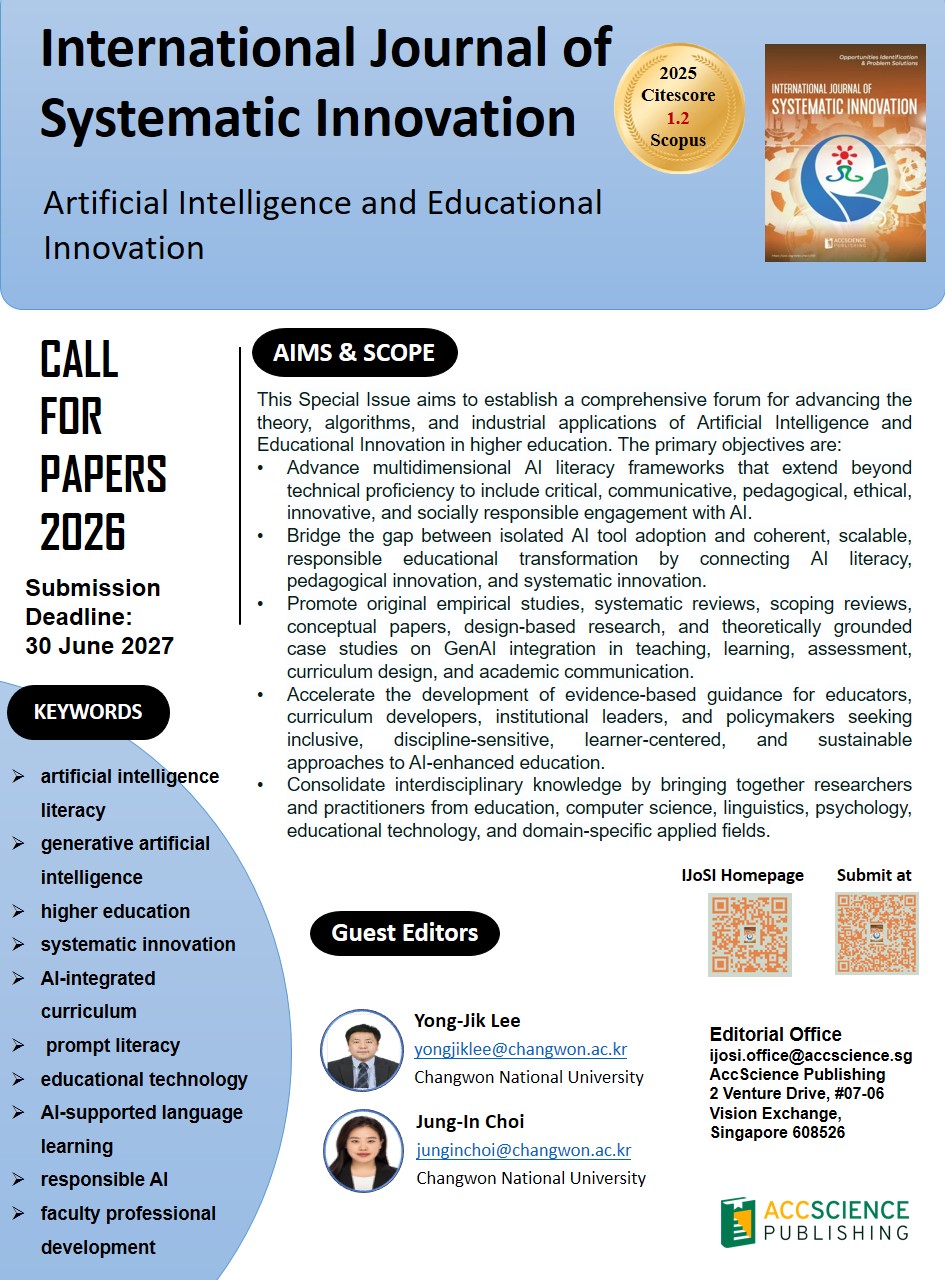
Artificial intelligence (AI), particularly generative artificial intelligence (GenAI), is rapidly reshaping teaching, learning, assessment, curriculum design, and academic communication in higher education. Yet access to AI tools does not necessarily lead to meaningful, critical, or ethically responsible use. Emerging evidence suggests that university students often show strong interest in AI and confidence in using accessible applications, including chatbots and translation tools, while their conceptual knowledge, prompt-design and language skills, technical foundations, and ability to evaluate AI-generated outputs remain uneven. These differences may reflect prior education in AI, software, and coding; disciplinary and academic backgrounds; linguistic experience; and the quality of students' learning opportunities.
This Special Issue invites original empirical studies, systematic reviews, scoping reviews, conceptual papers, design-based research, and theoretically grounded case studies on AI literacy, GenAI integration, and systematic innovation in higher education. Of particular interest are studies of students' and educators' AI competencies; prompt literacy; critical evaluation and ethical judgment; technology acceptance; disciplinary and cross-cultural differences; AI-supported language learning; AI-integrated curriculum and instructional design; faculty professional development; institutional policy; and systematic innovation methodologies for AI-enabled educational change. Contributions may use quantitative, qualitative, mixed-methods, longitudinal, experimental, comparative, or design-based approaches. International and interdisciplinary research is especially encouraged.