
A systematic innovation method for recoverable cross-border e-commerce services

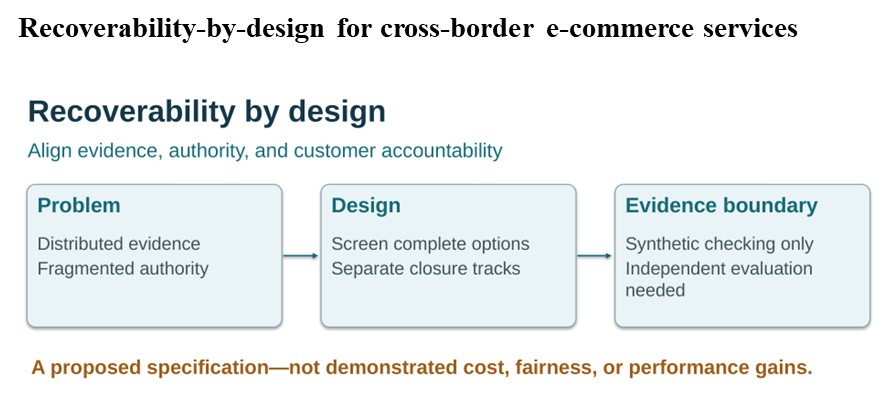
Distributed failures in cross-border e-commerce become difficult to resolve when evidence, remedy authority, and accountability lie with different organizations. This study develops the Recoverability-by-Design Method as an early-stage design-science specification for that coordination problem. Service recovery and perceived justice define evaluative objectives, cross-organizational governance explains the allocation problem, and the theory of inventive problem solving generates candidate options. A bounded knowledge base and a documented revision-stage search locate the proposal within established recovery and service-network approaches. Official records frozen on July 20, 2026 provide context, not recovery-performance observations. The specification separates configuration from case execution, current routing from root-cause diagnosis, and customer closure from partner-liability settlement. Five non-compensatory screens precede an anchored comparison of complete options, with combinations assessed separately. A declared synthetic example illustrates the intended records. All 24 retained regression checks and 36 additional input-contract checks return their expected outputs after implementation corrections. The preferred synthetic option changes in 96 of 256 weight configurations and five of 22 single-score perturbations. These are finite computational results under stated assumptions, not calibrated merit or independent validation. The contribution is an inspectable link among decision-specific evidence, authorized action, execution, and review, together with three conditional design propositions. Independent calibration, practitioner and customer assessment, organizational feasibility, and field effectiveness remain untested.
Adner, R. (2017). Ecosystem as structure: An actionable construct for strategy. Journal of Management, 43(1), 39–58. https://doi.org/10.1177/0149206316678451
Altshuller, G. S. (1984). Creativity as an exact science: The theory of the solution of inventive problems. Gordon and Breach, New York, NY.
AXELOS. (2019). ITIL Foundation: ITIL 4 edition. TSO, London, United Kingdom. https://abim.go.ug/sites/files/%28ITIL%29%20Axelos%20-%20ITIL%20Foundation%204%20edition-Axelos%20%282019%29%5B1%5D.pdf
Bai, L., Chu, T., & Fu, X. (2025). Triadic service failure and recovery: A literature review and guide to avenues for future research. Nankai Business Review International, 16(3), 444–470. https://doi.org/10.1108/NBRI-09-2024-0102
Bitner, M. J. (1990). Evaluating service encounters: The effects of physical surroundings and employee responses. Journal of Marketing, 54(2), 69–82. https://doi.org/10.1177/002224299005400206
Bitner, M. J., Ostrom, A. L., & Morgan, F. N. (2008). Service blueprinting: A practical technique for service innovation. California Management Review, 50(3), 66–94. https://doi.org/10.2307/41166446
Blodgett, J. G., Hill, D. J., & Tax, S. S. (1997). The effects of distributive, procedural, and interactional justice on postcomplaint behavior. Journal of Retailing, 73(2), 185–210. https://doi.org/10.1016/S0022-4359(97)90003-8
Chai, K.-H., Zhang, J., & Tan, K.-C. (2005). A TRIZ-based method for new service design. Journal of Service Research, 8(1), 48–66. https://doi.org/10.1177/1094670505276683
Dhanaraj, C., & Parkhe, A. (2006). Orchestrating innovation networks. Academy of Management Review, 31(3), 659–669. https://doi.org/10.5465/amr.2006.21318923
Eurasian Economic Commission. (2026). EEC Council sent draft Agreement on Electronic Commerce to Union countries to prepare for signing. https://eec.eaeunion.org/en/news/sovet-eek-napravil-proekt-soglasheniya-ob-elektronnoy-torgovle-v-strany-soyuza-dlya-podgotovki-k-pod/
Gadd, K. (2011). TRIZ for engineers: Enabling inventive problem solving. Wiley, Hoboken, NJ. https://doi.org/10.1002/9780470684320
Gawer, A. (2014). Bridging differing perspectives on technological platforms: Toward an integrative framework. Research Policy, 43(7), 1239–1249. https://doi.org/10.1016/j.respol.2014.03.006
Gregor, S., & Hevner, A. R. (2013). Positioning and presenting design science research for maximum impact. MIS Quarterly, 37(2), 337–355. https://doi.org/10.25300/MISQ/2013/37.2.01
Guide, V. D. R., Jr., & Van Wassenhove, L. N. (2009). The evolution of closed-loop supply chain research. Operations Research, 57(1), 10–18. https://doi.org/10.1287/opre.1080.0628
Hevner, A. R., March, S. T., Park, J., & Ram, S. (2004). Design science in information systems research. MIS Quarterly, 28(1), 75–105. https://doi.org/10.2307/25148625
Holloway, B. B., & Beatty, S. E. (2003). Service failure in online retailing: A recovery opportunity. Journal of Service Research, 6(1), 92–105. https://doi.org/10.1177/1094670503254288
Hu, Z.-Y., Zhu, X.-D., & Wu, L. (2019). Research on service recovery of cross-border e-commerce: Take JD Worldwide as an example. Journal of Chongqing Technology and Business University (Natural Science Edition), 36(6), 81–87. [In Chinese] https://journal.ctbu.edu.cn/zr/cqgszr/article/abstract/20190613
International Electrotechnical Commission. (2018). IEC 60812:2018: Failure modes and effects analysis (FMEA and FMECA). IEC, Geneva, Switzerland.
International Organization for Standardization. (2018a). ISO 10002:2018: Quality management—Customer satisfaction—Guidelines for complaints handling in organizations. ISO, Geneva, Switzerland.
International Organization for Standardization. (2018b). ISO 10003:2018: Quality management—Customer satisfaction—Guidelines for dispute resolution external to organizations. ISO, Geneva, Switzerland.
Jacobides, M. G., Cennamo, C., & Gawer, A. (2018). Towards a theory of ecosystems. Strategic Management Journal, 39(8), 2255–2276. https://doi.org/10.1002/smj.2904
Kyrgyz Republic. (2025a). Digital Code of the Kyrgyz Republic, No. 178. State Agency for Personal Data Protection. [In Russian] https://reestr.dpa.gov.kg/ru/npa/59
Kyrgyz Republic. (2025b). Law No. 179 on the enactment of the Digital Code of the Kyrgyz Republic. State Agency for Personal Data Protection. [In Russian] https://reestr.dpa.gov.kg/ru/npa/60
Lin, H., Beksultanov, A., Huang, W., Zhang, Y., Mukambaeva, I., & Adamkulova, C. (2026). Systematic innovation corridor design for China–Central Asia cross-border e-commerce. International Journal of Systematic Innovation, 10(4), Article 026200096. https://doi.org/10.6977/IJoSI.202608_10(4).0010
Liu, D., Zhao, Y., Wang, G., Schrock, W. A., & Voorhees, C. M. (2024). Thirty years of service failure and recovery research: Thematic development and future research opportunities from a social network perspective. Journal of Service Research, 27(2), 268–282. https://doi.org/10.1177/10946705231194006
Lusch, R. F., & Nambisan, S. (2015). Service innovation: A service-dominant logic perspective. MIS Quarterly, 39(1), 155–175. https://doi.org/10.25300/MISQ/2015/39.1.07
Mann, D. L. (2004). Hands-on systematic innovation for business and management. IFR Press, Clevedon, United Kingdom.
Maxham, J. G. (2001). Service recovery's influence on consumer satisfaction, positive word-of-mouth, and purchase intentions. Journal of Business Research, 54(1), 11–24. https://doi.org/10.1016/S0148-2963(00)00114-4
Michel, S., Bowen, D., & Johnston, R. (2009). Why service recovery fails: Tensions among customer, employee, and process perspectives. Journal of Service Management, 20(3), 253–273. https://doi.org/10.1108/09564230910964381
Ministry of Foreign Affairs of the People's Republic of China. (2025). List of outcomes of the Second China-Central Asia Summit. https://www.mfa.gov.cn/ziliao_674904/1179_674909/202506/t20250618_11652102.shtml
National Statistical Committee of the Kyrgyz Republic. (2025). Open data: Number of point-of-sale terminals, 2023–2024. [In Russian] https://stat.gov.kg/ru/opendata/category/5599/
Ostrom, A. L., Parasuraman, A., Bowen, D. E., Patrício, L., & Voss, C. A. (2015). Service research priorities in a rapidly changing context. Journal of Service Research, 18(2), 127–159. https://doi.org/10.1177/1094670515576315
Patrício, L., Fisk, R. P., Falcão e Cunha, J., & Constantine, L. (2011). Multilevel service design: From customer value constellation to service experience blueprinting. Journal of Service Research, 14(2), 180–200. https://doi.org/10.1177/1094670511401901
Peffers, K., Tuunanen, T., Rothenberger, M. A., & Chatterjee, S. (2007). A design science research methodology for information systems research. Journal of Management Information Systems, 24(3), 45–77. https://doi.org/10.2753/MIS0742-1222240302
Project Management Institute. (2021). A guide to the project management body of knowledge (PMBOK® Guide) and the standard for project management (7th ed.). Project Management Institute, Newtown Square, PA.
Savransky, S. D. (2000). Engineering of creativity: Introduction to TRIZ methodology of inventive problem solving. CRC Press, Boca Raton, FL. https://doi.org/10.1201/9781420038958
Shostack, G. L. (1984). Designing services that deliver. Harvard Business Review, 62(1), 133–139.
Smith, A. K., Bolton, R. N., & Wagner, J. (1999). A model of customer satisfaction with service encounters involving failure and recovery. Journal of Marketing Research, 36(3), 356–372. https://doi.org/10.1177/002224379903600305
Tax, S. S., Brown, S. W., & Chandrashekaran, M. (1998). Customer evaluations of service complaint experiences: Implications for relationship marketing. Journal of Marketing, 62(2), 60–76. https://doi.org/10.1177/002224299806200205
Tax, S. S., McCutcheon, D., & Wilkinson, I. F. (2013). The service delivery network (SDN): A customer-centric perspective of the customer journey. Journal of Service Research, 16(4), 454–470. https://doi.org/10.1177/1094670513481108
United Nations Commission on International Trade Law. (2016). Technical notes on online dispute resolution. United Nations, New York, NY.
Van Vaerenbergh, Y., Varga, D., De Keyser, A., & Orsingher, C. (2019). The service recovery journey: Conceptualization, integration, and directions for future research. Journal of Service Research, 22(2), 103–119. https://doi.org/10.1177/1094670518819852
Venable, J., Pries-Heje, J., & Baskerville, R. (2016). FEDS: A framework for evaluation in design science research. European Journal of Information Systems, 25(1), 77–89. https://doi.org/10.1057/ejis.2014.36
World Bank. (2026). World Development Indicators: Kyrgyz Republic, selected 2024 indicators. https://data.worldbank.org/indicator
Xitie Information [Xi'an Railway Bureau official account]. (2026). Surpassing 6,000 trains! [In Chinese]. The Paper. https://m.thepaper.cn/newsDetail_forward_32408362